PDPL Healthcare Privacy Compliance for Saudi Arabia

Protect sensitive health data with consent controls, role-based access, encryption, audit trails, and incident-response workflows built into the healthcare system.

What Is Saudi Arabia’s PDPL?

Saudi Arabia’s Personal Data Protection Law (PDPL) governs how organisations collect, use, store, disclose, retain, and protect personal data. Health data is classified as sensitive personal data and is subject to additional safeguards, including tighter access restrictions and stronger controls over processing and disclosure.

For healthcare providers, PDPL readiness requires more than a privacy policy. The underlying hospital or clinic system must support consent, purpose limitation, least-privilege access, secure data handling, traceable activity, incident response, and evidence for regulatory review.


PDPL-Ready Data Governance for Every Healthcare Setting

Protect high-volume patient data across clinical, administrative, financial, pharmacy, laboratory, radiology, and insurance workflows.

  • Role-based access across departments, specialties, and job functions
  • Consent and lawful-basis capture throughout the patient journey
  • Encrypted storage and secure exchange of clinical information
  • Complete logs for record access, edits, downloads, and exports
  • Incident investigation and breach-response documentation
  • Data-retention and disposal controls across the patient lifecycle

Apply consistent privacy controls to registration, consultations, diagnostics, prescriptions, billing, and patient communication.

  • Quick consent capture at registration and digital touchpoints
  • Access controls for physicians, nurses, reception, billing, and management
  • Secure handling of patient files, attachments, and diagnostic results
  • Audit trails for viewing, updating, printing, and sharing records
  • Privacy controls for single-site and multi-branch clinic operations
  • Structured responses to patient data-access and correction requests

Standardise patient-data governance across laboratories, imaging centres, hospitals, clinics, and multiple legal entities.

  • Centralised privacy policies with facility-level access boundaries
  • Controlled sharing of orders, results, reports, and images
  • Multi-site audit visibility and cross-facility monitoring
  • Consistent retention, disclosure, and export controls
  • Consolidated incident tracking and remediation workflows
  • Group-level reporting for DPO, compliance, and internal audit teams

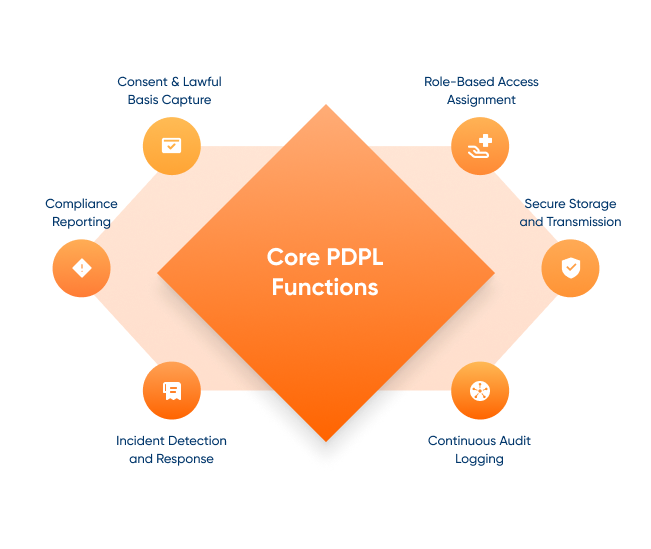
The Personal Data Protection Law Workflow in Medinous

A connected path from patient-data capture to audit-ready evidence.

Workflow infographic
1
Consent & Lawful Basis Capture
Record consent or the applicable lawful basis when personal and health data is collected.
2
Role-Based Access Assignment
Define what each user can view, create, edit, approve, download, print, or export.
3
Secure Storage and Transmission
Protect patient data at rest and in transit using configured encryption and secure exchange controls.
4
Continuous Audit Logging
Timestamp access, edits, approvals, downloads, printing, disclosure, and export activity.
5
Incident Detection and Response
Flag unusual activity, investigate events, document actions, and coordinate breach-response workflows.
6
Compliance Reporting
Generate structured evidence for the DPO, internal audit, management review, or regulatory requests.
KEY PRODUCT CAPABILITIES

Build PDPL-Ready Data Governance into Every Workflow

Role-Based Access Control

Apply least-privilege access so physicians, nurses, technicians, billing staff, administrators, and external users see only the information needed for their roles.

Consent and Preference Tracking

Capture, update, and retrieve patient consent and communication preferences across registration, treatment, research, and digital engagement workflows.

Encryption at Rest and in Transit

Protect sensitive health data while stored and while exchanged between authorised systems, users, facilities, and integrated services.

Comprehensive Audit Logging

Maintain a traceable history of who accessed a patient record, what they changed, when the action occurred, and whether data was printed, downloaded, or exported.

Incident and Breach-Response Documentation

Record alerts, investigation findings, affected records, containment actions, decisions, notifications, and remediation in one structured workflow.

SDAIA Reporting Readiness

Organise policies, logs, consent evidence, incident records, access reports, and corrective actions for compliance review and regulatory response.

Privacy Governance That Supports Better Operations

Performance Gains from PDPL-Ready Governance

Fewer manual audit-prep cycles — structured evidence sitting in the system already, not assembled after a request comes in. 

  • Stronger evidence of consent, access control, and lawful processing
  • Traceable records for audits and regulatory enquiries
  • Structured incident and breach-response documentation
  • Clearer accountability across controllers, processors, users, and facilities

One access-control architecture instead of a generic EHR permissions model patched together after the fact.

  • Less manual effort when preparing audit evidence
  • Faster investigation of unusual record activity
  • Consistent privacy controls across departments and locations
  • Reduced dependence on spreadsheets and disconnected logs

Security controls that don't add friction to how clinicians access records during actual patient care.

  • Appropriate access to patient information at the point of care
  • Secure collaboration across authorised care teams
  • Less exposure from unnecessary or overly broad record access
  • Greater patient confidence in how health information is handled

Resources

Ebook

10 Steps to Choose the Right Hospital Management System

A practical guide to selecting a unified, future-ready HMS for smarter clinical, financial, and operational performance.

Download now

Ebook

The Modern CMO’s Playbook: Leading Clinical Quality in a Digitally Driven Hospital

A nine-step guide for Chief Medical Officers to build high-reliability, system-led clinical excellence.

Download now

Frequently Asked Questions

Yes. Health data is treated as sensitive personal data. Saudi PDPL materials require additional safeguards and specifically call for access to health data and medical files to be limited to the minimum number of personnel necessary to provide healthcare or insurance services.
SDAIA is identified as the competent authority responsible for supervising, investigating, and enforcing PDPL compliance. Healthcare organisations should verify current guidance and reporting procedures through official SDAIA channels.
No software can make an organisation compliant on its own. Compliance also depends on governance, policies, lawful processing, contracts, staff behaviour, training, retention practices, incident handling, and regulatory interpretation. Medinous provides system controls and evidence that support these responsibilities.
Role-based access control limits patient information and system actions according to a user’s authorised responsibilities. A physician, nurse, receptionist, coder, billing executive, administrator, and laboratory technician can each receive different access.
Consent is one possible lawful basis, but not the only consideration. The appropriate basis depends on the purpose and circumstances of processing. Healthcare providers should document the lawful basis used and obtain explicit consent where required for sensitive data.
A useful audit trail should record the user, patient record, action, date and time, location or system context, and relevant before-and-after details for sensitive changes. It should also cover printing, downloading, disclosure, and export activity where applicable.
Yes. Medinous can support centralised policies, role-based access, facility boundaries, consent tracking, audit reporting, incident workflows, and consolidated oversight across hospital and clinic groups.

Why Healthcare Organizations Choose Medinous

  • A mature platform refined through decades of healthcare innovation and continuous R&D
  • Cloud-native, cloud-first platform architecture
  • Excellent customer support
  • Enterprise-grade service management supported by SLA and ITIL-based practices
  • Ability to customize & Integrate
Get a demo
hospital information system software