AR-DRG Readiness for Hospitals in Saudi Arabia

Prepare your clinical documentation, ICD-10-AM coding, case-mix reporting, and billing workflows for Saudi Arabia’s evolving AR-DRG reimbursement framework.

What Is AR-DRG?

AR-DRG, or Australian Refined Diagnosis-Related Groups, is a case-mix classification system used to group inpatient encounters based on diagnoses, procedures, complications, comorbidities, and expected resource use.

As Saudi Arabia advances towards value-based and case-mix-based reimbursement, healthcare providers need stronger documentation, coding, reporting, and financial workflows. Early AR-DRG readiness helps facilities identify gaps before they affect case classification, reimbursement accuracy, and revenue performance.

AR-DRG Readiness for Every Healthcare Setting

Build AR-DRG-ready documentation, coding, billing, and reporting workflows before operations begin.

  • Standardised clinical documentation from day one
  • ICD-10-AM-aligned diagnosis and procedure coding
  • Case-mix reporting across departments
  • Coding review and approval workflows
  • AR-DRG grouper integration readiness
  • Shadow billing before live reimbursement begins

Assess current clinical and coding practices to identify gaps that may affect AR-DRG classification and reimbursement.

  • Documentation completeness assessments
  • Coding quality and consistency reviews
  • Historical encounter analysis
  • Case-mix index visibility
  • Shadow billing alongside current claims
  • Documentation and coding gap remediation

Standardise AR-DRG readiness across multiple hospitals, specialties, regions, and coding teams.

  • Group-wide documentation standards
  • Centralised coding governance
  • Facility-level case-mix comparison
  • Multi-hospital shadow billing
  • Consolidated readiness dashboards
  • Consistent audit and remediation workflows

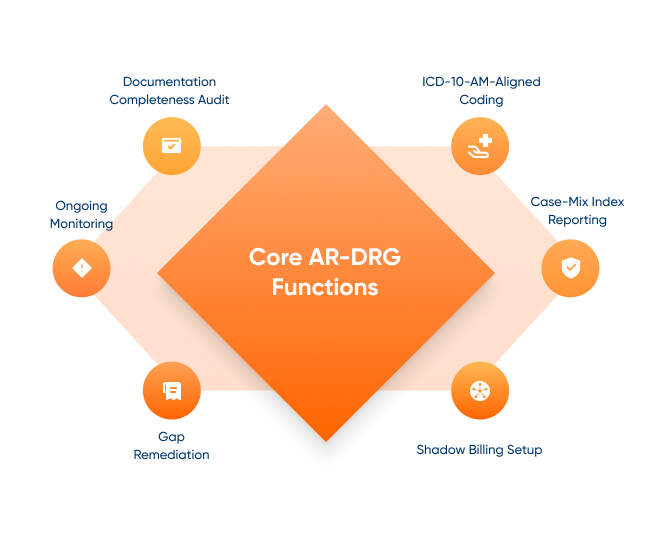
The AR-DRG Readiness Path in Medinous

A structured route from current documentation and coding practices to stronger case-mix confidence.

Workflow infographic
1
Documentation Completeness Audit
Identify missing diagnoses, procedures, complications, comorbidities, and discharge details that may affect AR-DRG grouping.
2
ICD-10-AM-Aligned Coding
Align diagnosis and procedure coding practices with the classifications referenced within Saudi Arabia’s healthcare framework.
3
Case-Mix Index Reporting
Track case-mix performance across facilities, departments, specialties, physicians, and reporting periods.
4
Shadow Billing Setup
Run AR-DRG grouping and indicative valuation alongside current billing without affecting live claims or reimbursement.
5
Gap Remediation
Address documentation, coding, workflow, and configuration gaps identified through audits and shadow billing.
6
Ongoing Monitoring
Monitor coding quality, documentation completeness, case-mix movement, and readiness as Saudi AR-DRG requirements evolve.
KEY PRODUCT CAPABILITIES

Strengthen AR-DRG Readiness Across Every Case

Documentation Completeness Scoring

Assess whether each patient record contains the clinical detail required for accurate coding and AR-DRG grouping. Medinous helps identify missing diagnoses, procedures, complications, comorbidities, and discharge information before incomplete documentation affects case classification and potential reimbursement.

ICD-10-AM Coding Support

Support coding teams with access to the diagnoses, procedures, investigations, medications, and discharge details required for accurate coding. Structured coding workflows help improve consistency, reduce manual review, and identify cases that require additional clinical clarification.

Case-Mix Index Dashboards

Monitor case-mix performance across hospitals, departments, specialties, physicians, and time periods. Dashboards help leadership identify unexpected variations that may result from changes in patient complexity, documentation quality, coding practices, or service mix.

Shadow Billing Engine

Run AR-DRG grouping and indicative valuation on real encounters without affecting actual claims or reimbursement. Shadow billing gives clinical, coding, finance, and revenue-cycle teams visibility into how documentation and coding gaps may influence AR-DRG assignment, case-mix index, and potential reimbursement outcomes.

Gap Remediation Tracking

Convert findings from documentation audits, coding reviews, and shadow billing into structured corrective actions. Assign gaps to clinical, coding, finance, or operational teams and track ownership, priority, progress, and closure from one workflow.

Regulatory Readiness Monitoring

Maintain a clear view of internal AR-DRG readiness as Saudi guidance, coding standards, and reimbursement requirements evolve. Track completed assessments, training, workflow changes, audit findings, system configurations, and outstanding readiness actions.

BENEFITS FOR HOSPITALS & CLINICS

Performance Gains from AR-DRG Readiness

Visibility into case-mix-driven revenue exposure before a mandate arrives, not after.

  • Earlier visibility into potential reimbursement impact
  • Stronger case-mix and revenue forecasting
  • Identification of documentation-related revenue gaps
  • Better preparation for case-mix-based contracting
  • Improved understanding of service-line performance

Coding and documentation habits built gradually, not retrofitted under deadline pressure.

  • More complete clinical documentation
  • Standardised ICD-10-AM coding workflows
  • Faster identification of cases requiring review
  • Better coordination between clinical, coding, finance, and IT teams
  • Consistent readiness across facilities and departments

A documented readiness position if CHI's implementation timeline moves faster than expected.

  • A documented AR-DRG readiness position
  • Traceable coding and documentation reviews
  • Structured audit and gap-remediation workflows
  • Greater preparedness as Saudi requirements evolve
  • Ongoing visibility into unresolved readiness risks

Resources

Ebook

10 Steps to Choose the Right Hospital Management System

A practical guide to selecting a unified, future-ready hospital management system for stronger clinical, financial, and operational performance.

Download now
Ebook

The Modern CMO’s Playbook: Leading Clinical Quality in a Digitally Driven Hospital

A nine-step guide for Chief Medical Officers to build high-reliability, system-led clinical excellence.

Download now

Frequently Asked Questions

Saudi Arabia is progressing towards case-mix-based and value-based reimbursement, with AR-DRG referenced within the national healthcare classification framework. Healthcare providers should continue to monitor official CHI guidance for current implementation requirements and timelines.
No. NPHIES supports the exchange of healthcare insurance transactions such as eligibility, authorisation, claims submission, and payment information. AR-DRG is a case-mix classification system that groups inpatient encounters according to clinical complexity and expected resource use.
Shadow billing processes real encounters through an AR-DRG grouping and financial-simulation workflow without changing the actual claim. It helps healthcare providers assess documentation quality, coding accuracy, case-mix impact, and potential reimbursement outcomes before implementation.
AR-DRG grouping depends on the diagnoses, procedures, complications, comorbidities, and other clinical details recorded during the encounter. Incomplete documentation may result in a case classification that does not accurately reflect patient complexity or the resources used.
Yes. Medinous supports centralised documentation standards, coding governance, case-mix reporting, shadow billing, audit workflows, and gap-remediation tracking across hospital groups and healthcare networks.

Why Healthcare Organizations Choose Medinous

  • A mature platform refined through decades of healthcare innovation and continuous R&D
  • Cloud-native, cloud-first platform architecture
  • Excellent customer support
  • Enterprise-grade service management supported by SLA and ITIL-based practices
  • Ability to customize & Integrate
Get a demo
hospital information system software