ZATCA E-Invoicing for Healthcare Facilities in Saudi Arabia

Generate, clear, report, and securely store Fatoora-compliant electronic invoices while keeping ZATCA tax workflows separate from NPHIES insurance billing.

What Is ZATCA E-Invoicing?

ZATCA e-invoicing, also known as Fatoora, requires VAT-registered taxpayers in Saudi Arabia to generate and store electronic invoices through compliant systems. Phase 2 adds integration with ZATCA, structured invoice formats, additional data fields, and clearance or reporting requirements.

For healthcare facilities, ZATCA governs tax invoices and notes. NPHIES governs insurance eligibility, pre-authorisation, claims, and payer transactions. Medinous keeps both workflows connected to the same patient account while maintaining the required operational and regulatory separation.

ZATCA E-Invoicing for Every Healthcare Setting

Manage high-volume tax invoicing across outpatient, inpatient, emergency, pharmacy, laboratory, radiology, and other hospital departments.

  • Centralised ZATCA e-invoicing across departments
  • Tax invoices for self-pay, co-pay, and VAT-applicable services
  • B2B and B2C invoice workflows
  • Credit and debit note processing
  • Multi-cashier and multi-location controls
  • Financial reconciliation and audit trails

Generate compliant invoices quickly for consultations, procedures, diagnostics, medicines, and patient payments.

  • Fast point-of-billing invoice generation
  • Simplified tax invoices with QR codes
  • Automatic VAT and service mapping
  • Real-time clearance or reporting
  • Compliant invoice corrections
  • Branch-level and consolidated reporting

Standardise ZATCA e-invoicing across multiple healthcare facilities while maintaining central financial oversight.

  • Group-wide invoice rules and tax configuration
  • Facility and branch-level Fatoora integration
  • Centralised compliance dashboards
  • Consistent credit and debit note workflows
  • Consolidated audit and reconciliation reporting
  • Role-based access across entities

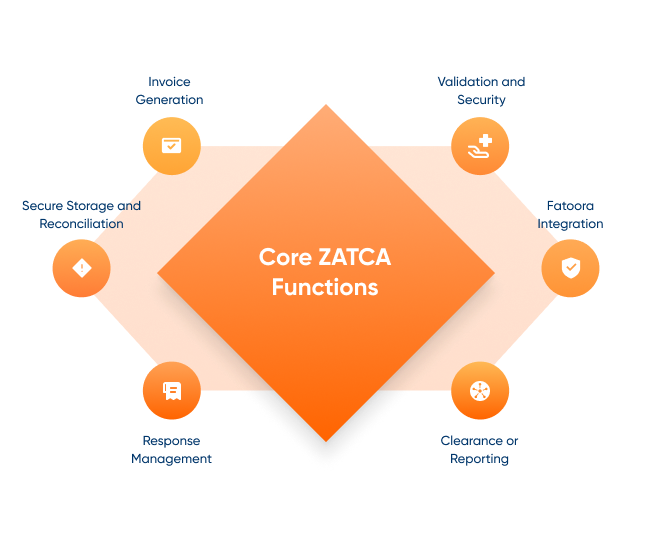
The ZATCA Workflow in Medinous

A structured path from healthcare billing to Fatoora-compliant invoice clearance and reporting.

Workflow infographic
1
Invoice Generation
Generate structured tax invoices or simplified tax invoices using charges captured within the healthcare billing workflow.
2
Validation and Security
Validate required fields and apply the applicable UUID, cryptographic stamp, QR code, and security controls.
3
Fatoora Integration
Transmit invoice data to ZATCA through the required Phase 2 integration workflow.
4
Clearance or Reporting
Process tax invoices for clearance and simplified tax invoices for reporting according to the applicable transaction type.
5
Response Management
Receive and record ZATCA responses, statuses, timestamps, and validation outcomes.
6
Secure Storage and Reconciliation
Store invoices and notes securely and reconcile them with patient billing, finance, and tax records.
Why ZATCA E-Invoicing Matters for Healthcare

Unified Billing Across Insurance, Patient Payments, and Taxes

Self-Pay and Co-Pay Charges

Generate Fatoora-compliant invoices for cash payments, card payments, deposits, and patient co-payments independently of the insurance claim status.

Insurance-Covered Services

Process payer eligibility, pre-authorisation, and claims through NPHIES while applying ZATCA requirements only to the relevant tax invoice or patient-payment transaction.

Mixed Billing Scenarios

Split patient, payer, taxable, and exempt components correctly when one encounter includes insurance coverage, co-payment, exclusions, medicines, and additional services.

BENEFITS FOR HOSPITALS & CLINICS

Operational Gains from ZATCA-Ready Healthcare Billing

  • More accurate tax treatment across patient transactions
  • Faster invoice reconciliation and month-end closure
  • Reduced duplicate billing and manual tax entry
  • Clearer separation of patient, payer, and tax amounts
  • One workflow from service capture to electronic invoice
  • Fewer manual uploads and disconnected billing tools
  • Faster cashier and front-desk processing
  • Central visibility across facilities and branches
  • Structured invoices and notes aligned with Fatoora requirements
  • Traceable clearance and reporting statuses
  • Complete invoice and user audit histories
  • Readiness for the facility’s notified Phase 2 wave

Resources

Ebook

10 Steps to Choose the Right Hospital Management System

A practical guide to selecting a unified, future-ready HMS for smarter clinical, financial, and operational performance.

Download now

Ebook

The Modern CMO’s Playbook: Leading Clinical Quality in a Digitally Driven Hospital

A nine-step guide for Chief Medical Officers to build high-reliability, system-led clinical excellence.

Download now

Frequently Asked Questions

No. ZATCA governs electronic tax invoices, credit notes, debit notes, and reporting to the tax authority. NPHIES governs insurance eligibility, pre-authorisation, claims, and payer transactions. A healthcare facility must manage each requirement through the correct workflow.
A facility selected for Phase 2 should verify its official ZATCA notification and integration deadline immediately. Non-compliance may expose the taxpayer to operational disruption or penalties under applicable tax regulations.
Wave 25 includes taxpayers whose VAT-subject revenues exceeded SAR 187,500 during 2022, 2023, 2024, or 2025. Applicability depends on the taxpayer’s VAT status, revenue, and direct notification from ZATCA, not simply on whether the organisation is a clinic or hospital.
Standard tax invoices generally follow a clearance workflow before they are shared with the buyer. Simplified tax invoices generally follow a reporting workflow within the prescribed period. The correct workflow depends on the invoice and transaction type.
Yes. Medinous can support centralised tax configuration, facility-level invoice processing, role-based access, consolidated reporting, and audit trails across hospital and clinic groups.
Yes. Medinous uses services, medicines, procedures, payments, and patient billing information already captured in the healthcare workflow to generate the corresponding electronic invoice.

Why Healthcare Organizations Choose Medinous

  • A mature platform refined through decades of healthcare innovation and continuous R&D
  • Cloud-native, cloud-first platform architecture
  • Excellent customer support
  • Enterprise-grade service management supported by SLA and ITIL-based practices
  • Ability to customize & Integrate
Get a demo
hospital information system software